
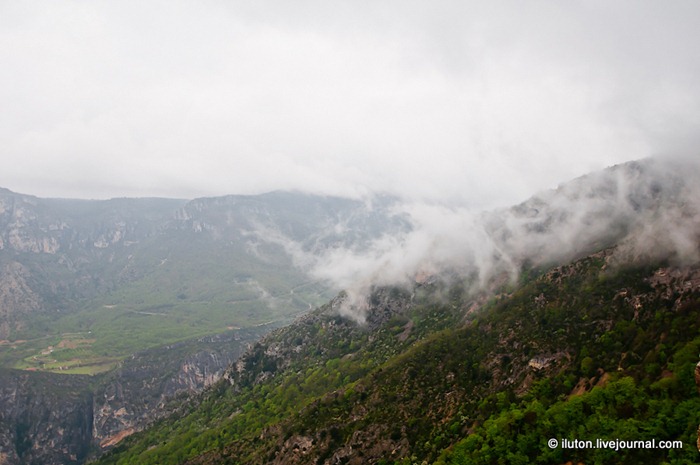
The Verdon Gorge in south-eastern France has been dubbed the Grand Canyon of Verdon because of its topological similarities with the Grand Canyon of the Colorado River, United States. The Grand Canyon of Verdon is about 25 kilometers long and up to 500 meters deep and measures 200 to 1500 meters from one side of the Gorge to the other. It is formed the Verdon River, which is named after its startling turquoise-green colour, one of the canyon's most distinguishing characteristics. The most impressive part lies between the towns of Castellane and Moustiers-Sainte-Marie, where the river has cut a ravine up to 500 metres down through the limestone mass. At the end of the canyon, the Verdon river flows into the artificial lake of Sainte-Croix-du-Verdon.

Because of its proximity to the French Riviera, the canyon is very popular with tourists, who can drive around its rim, rent kayaks or hike. The limestone walls, which are several hundreds of meters high, attract many rock climbers. It is considered an outstanding destination for multi-pitch climbing. There are routes encompassing cracks, pillars and seemingly endless walls. The climbing is generally of a technical nature, and there are over 1,500 routes, ranging from 20m to over 400m.




Pictures: http://iluton.livejournal.com/
Because of its proximity to the French Riviera, the canyon is very popular with tourists, who can drive around its rim, rent kayaks or hike. The limestone walls, which are several hundreds of meters high, attract many rock climbers. It is considered an outstanding destination for multi-pitch climbing. There are routes encompassing cracks, pillars and seemingly endless walls. The climbing is generally of a technical nature, and there are over 1,500 routes, ranging from 20m to over 400m.
Pictures: http://iluton.livejournal.com/

%5B3%5D.jpg "huashan mountain road (3)")
%5B3%5D.jpg "huashan mountain road (4)")
%5B3%5D.jpg "huashan mountain road (6)")
%5B5%5D.jpg "huashan mountain road (2)")







![Crosses Hill [www.ritemail.blogspot.com]](https://blogger.googleusercontent.com/img/b/R29vZ2xl/AVvXsEg9hTopP3K6PRjJAKDsu31U60HmsYcy-jJx_2Uw8PrbW-KFN0-fkVk3p__q8k3STPpvsXQLgyv0pnYKhF2c10dcONB_Te183CaE0yMKRYQ8ex_NYhgn5SHtZFN150qkGSYX3A6jY5DSJEFS/s1600-h/crosses_hill4.jpg)
![Crosses Hill [www.ritemail.blogspot.com]](https://blogger.googleusercontent.com/img/b/R29vZ2xl/AVvXsEj_wRChsC86cUwG_ocFPZRyCpIH-8p0oKEoZTvCVCaW-lQF-roZ2a1F3GZa184dFefLP8IIY-vBBclT9WxDS0ZcOUsixjQknLVfHID3sG-AhMxWnix3V6miNK3N3pZ3QPpeMsT7yfJG5m4J/s1600-h/crosses_hill1.jpg)
![Crosses Hill [www.ritemail.blogspot.com]](https://blogger.googleusercontent.com/img/b/R29vZ2xl/AVvXsEipDSx-EniE24IoCASmecJ9RUxPurq6pevYnyT38oajkb476Sxdg_fS7jJkq9xSJdXKfyfWol5rboAaf_GXH6qsQ0zVCqQCoS7sUnHFwrY92388cKu_HHCGc9W1oZV-vw1O1lDk8wwPKOuY/s1600-h/crosses_hill2.jpg)
![Crosses Hill [www.ritemail.blogspot.com]](https://blogger.googleusercontent.com/img/b/R29vZ2xl/AVvXsEimjiyuq7IbNG8xKK4huCak7M_BIEvMSXoXTyobKUdQoLUkxnKObOMFesFPd27kKKYjRCYxOObYNYXifhhgsTOhnMb3weH4dTWn4JZD0J_xSGYrZaI7TnlUIPzNg2rD1vidikm4l3jSYOHw/s1600-h/crosses_hill3.jpg)
![Crosses Hill [www.ritemail.blogspot.com]](https://blogger.googleusercontent.com/img/b/R29vZ2xl/AVvXsEh3rlb02KGQdqexqfbaNLgUVRha23aNgwADS93zDk4tfXmsyncm1x814IUcarkg8Wdj-g69TEVU60MSx-oMd-ATMoVDBQM1EREGHIu97NAuVgW0ntmurdIgAD21qyNr5t-fM7f1iWu7jyVv/s1600-h/crosses_hill5.jpg)
![Crosses Hill [www.ritemail.blogspot.com]](https://blogger.googleusercontent.com/img/b/R29vZ2xl/AVvXsEiUyf32uwlHyf2XbwYGQL9K1_gKmoZlOTCYznzZrvpVu7kw0eIAdlR4XGbv8f7Pm0P8KQ2afUs2K7kcSZ5DO4hGCQ_lPuY4pkWtITvg4V-vW9IOIhSOqA0iJYK2e27FL-QfMHa4PUUSVfao/s1600-h/crosses_hill6.jpg)
![Crosses Hill [www.ritemail.blogspot.com]](https://blogger.googleusercontent.com/img/b/R29vZ2xl/AVvXsEi9ZcNeUVxHJzR_3tduk1vfy7NJSq6P7W5idXqGy5jWDFxKp8OrcAA0ny5Bqk5zEtlJ9L95NhcQoTaGEu7TAmL3Uqze8sQxNS7bfcCa76mlOACMopU5WXXrji_y70aGUpMtUjA3lUih0Eln/s1600-h/crosses_hill7.jpg)
![Crosses Hill [www.ritemail.blogspot.com]](https://blogger.googleusercontent.com/img/b/R29vZ2xl/AVvXsEiIGBGJHQGFnX3lNmD84KZQ7mC-hz-W2m9MIaCdmruVkj0nIGEHGtO3bMD26gPNJV7ePdJC8RtrwpJ9mAKmBvlqNyhflUJiGZJ4UriTuZ-sTyCgmowXXtWUkCTPco8eZIiDbziKT4ukx73U/s1600-h/crosses_hill8.jpg)
![Crosses Hill [www.ritemail.blogspot.com]](https://blogger.googleusercontent.com/img/b/R29vZ2xl/AVvXsEhhkgxPi0rMBBSZTj7G5rqhwUInT2acKKkHQDkeXNrDWTjGjyERGVV1xC76AUGn0Y6xEzKhk23U5b5M0sCJc7otU-LTA7WqrSuIiw3M27Kn18BdRVItrpgb5BInNgnGOyr9CSuPvnUyK-iZ/s1600-h/crosses_hill9.jpg)
![Crosses Hill [www.ritemail.blogspot.com]](https://blogger.googleusercontent.com/img/b/R29vZ2xl/AVvXsEg7D2QBkt_tN-5Q-U5LG65tZl9QwQD0-EyZLf9f_W5hzKpWz4P-E33B6aV-f-RvT4APDrcdjTk3Ca_NO3iKaI74stubC-zIwVkwzT4wUZ3sdgbftZsx7c08GCU8mLIzUu6pesrM-OMH3nwW/s1600-h/crosses_hill11.jpg)
![Crosses Hill [www.ritemail.blogspot.com]](https://blogger.googleusercontent.com/img/b/R29vZ2xl/AVvXsEjb0yNNFDKPqvVTG2TNYUQvDj3h425qqOPAdahqUfr16h8ag7Vocq0QSbcxmRQ9k6O5jPFO935nJCizb5HkAkj5mXcYVgeeNxvsjjuJf5DEJfVwTfp83KKjJU343R_aMjWg1O0h7HBW6J6s/s1600-h/crosses_hill10.jpg)


